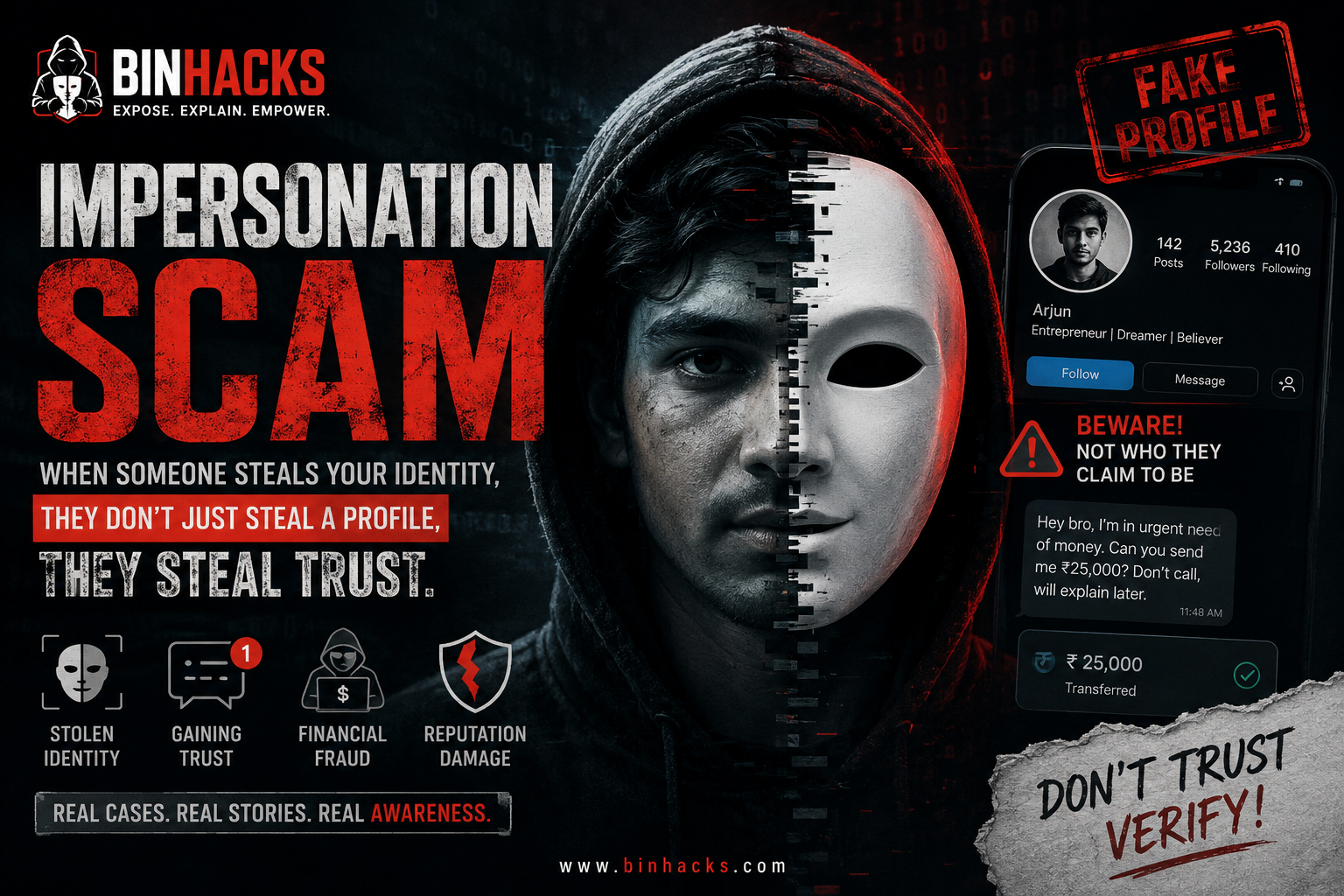
When someone steals your identity, they don’t just steal a profile — they steal trust.
A familiar face. A fake account. A very real victim.
01 — THE CASE
Someone is pretending to be you.
An impersonation scam begins with something that looks harmless: a copied photograph, a familiar name, or a profile that appears almost identical to the real person.
Then the messages begin.
Friends receive requests. Followers are contacted. Money is requested. Personal information is collected.
The victim may not even know it is happening.
This investigation follows how an ordinary online identity can be transformed into a weapon for deception.
02 — HOW THE SCAM WORKS
The Impersonation Pipeline
01 — FIND
The scammer identifies a public profile and collects information that is already visible online.
02 — COPY
Profile photographs, names, biographies, and publicly available details are replicated.
03 — BUILD
A convincing fake account is created to resemble the original identity.
04 — CONNECT
The fake account sends follow requests or messages to people who already trust the impersonated person.
05 — MANIPULATE
The scammer creates urgency — an emergency, investment opportunity, payment request, relationship story or other believable situation.
06 — PROFIT
Money, credentials, personal information or access may ultimately be targeted.
03 — THE DIGITAL CRIME SCENE
What investigators look for
PROFILE
- Username changes
- Account creation clues
- Copied photographs
- Bio similarities
- Suspicious follower patterns
MESSAGES
- Repeated scripts
- Urgency
- Requests for money
- Suspicious links
- Attempts to move conversations elsewhere
DIGITAL EVIDENCE
- Screenshots
- Profile URLs
- Message timestamps
- Publicly visible account information
- Relevant transaction records
One screenshot can become the first piece of a much bigger investigation.
04 — THE RED FLAGS
Could you spot the fake?
⚠️ New account + familiar identity
⚠️ Slightly different username
⚠️ Sudden request for money
⚠️ “Don’t tell anyone.”
⚠️ Pressure to act immediately
⚠️ Unusual payment request
⚠️ Suspicious links
⚠️ Account refuses verification
05 — REAL IMPACT
The victim doesn’t lose a password.
They can lose trust.
A fake profile can damage someone’s reputation, manipulate friends and family, cause financial losses, and lead to long-term emotional consequences.
The most dangerous part?
The scammer doesn’t need to become you.
They only need to become believable enough.
06 — BINHACKS INVESTIGATION
From profile → evidence → awareness
Our investigation methodology focuses on documenting publicly available evidence and explaining the scam chain in a way ordinary users can understand.
We ask:
Who created the identity?
How was the profile copied?
Who was contacted?
What manipulation techniques were used?
What evidence exists?
How could the victim have detected the warning signs earlier?
07 — EVIDENCE BOARD
CASE FILE: IMPERSONATION
CASE TYPE
Online Identity Impersonation
PRIMARY PLATFORM
Social Media
TARGET
Individual / Community
TACTIC
Identity Cloning + Social Engineering
OBJECTIVE
Trust Manipulation
POTENTIAL IMPACT
Financial Loss • Reputation Damage • Privacy Exposure
STATUS
DOCUMENTED FOR AWARENESS
08 — WHAT TO DO IF YOU’RE IMPERSONATED
Don’t panic. Preserve evidence first.
1. Screenshot the fake profile.
2. Save the profile URL and username.
3. Document suspicious messages.
4. Warn friends and family through a trusted channel.
5. Report the impersonating account through the platform’s official reporting system.
6. If money or sensitive information was involved, preserve transaction and communication records.
7. Report the incident to the appropriate cybercrime authorities.
Don’t delete the evidence before documenting it.
THE FINAL QUESTION
How much of your identity is already public?
Your name.
Your photographs.
Your workplace.
Your friends.
Your location clues.
Your daily routine.
Individually, these details may seem harmless.
Together, they can become a blueprint for deception.
BINHACKS
REAL CASES. REAL STORIES. REAL AWARENESS.
We investigate the scam.
We explain the method.
You learn the warning signs.
DON’T TRUST THE PROFILE.
VERIFY THE PERSON.
BINHACKS — EXPOSE THE DIGITAL DECEPTION.